
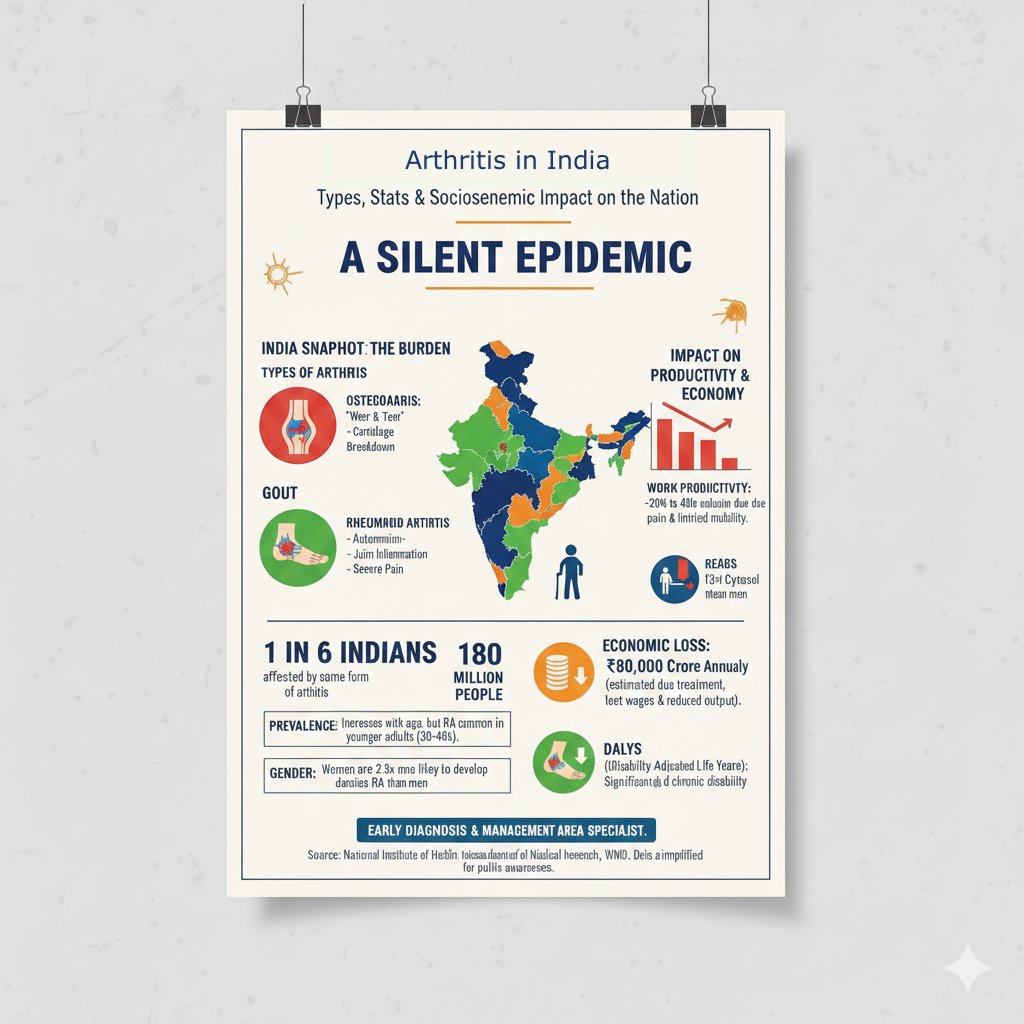
A healthy immune system is essential for protecting and defending the body against diseases and infections. Sometimes, the immune system malfunctions and attacks healthy tissues and organs; these are termed autoimmune diseases. Approximately 80 autoimmune diseases are recognised, and of these, psoriasis and rheumatoid arthritis are the most common. According to The Lancet Rheumatology, 17.6 million people worldwide have rheumatoid arthritis (RA), in which the patient’s immune system attacks the patient’s own joints, causing inflammation. The other types of autoimmune arthritis are relatively rare and can be challenging to diagnose at times. This leads to delayed medical care and permanent joint deformities.
Recent reviews indicate that the prevalence of RA in India ranges from 0.28 to 0.7%. Though it is a common disorder, not many people seek immediate medical treatment or make necessary lifestyle changes for it until the pain dominates much of their daily life. Of the total arthritis cases visiting Home of Homeo, 25% are autoimmune arthritis cases.
There has been a steady increase in the number of autoimmune arthritis cases over the past two decades. Studies suggest that both genetic and environmental factors influence the autoimmune process. Environmental exposure to asbestos, pesticides, gender, race, ethnicity, emotional and mental stress, smoking, and obesity are some of the known risk factors for the development of autoimmune arthritis. It is essential to note that although autoimmune arthritis primarily affects the joints, many patients experience symptoms in non-joint organs, including the eyes, lungs, kidneys, skin, blood vessels, and heart.
Early recognition of arthritis features helps prevent irreversible joint damage and disability. With so many types of arthritis, it is essential to accurately identify the condition and provide your doctor with the correct symptom picture and medical history. As Autoimmune Arthritis affects the body as a whole, fever, weakness, and excessive fatigue are common findings.
The following are the symptoms of different types of arthritis that you should look out for if you are experiencing joint pain.
Rheumatoid Arthritis
About 70% of people living with RA are women, and 55% are older than 55 years. Smaller joints, such as those in the hands, feet, and wrists, are more commonly affected. Typically, the condition is symmetrical, meaning both right and left joints are affected simultaneously. The joints are stiff upon waking in the morning, and rheumatoid nodules may form at the site of pressure.
Psoriatic Arthritis
Primarily affects individuals with an autoimmune skin condition called psoriasis. There are red scaly rashes of psoriasis, especially on the elbows, knees, and scalp. Psoriatic Arthropathy can affect any joint and is not symmetrical.
Reactive Arthritis
Occurs in people who have suffered from a Chlamydia, Salmonella, or Shigella infection. The patient reports a history of a urinary tract infection before the onset of joint symptoms. Besides joint pain and swelling, it also causes redness in the eyes, burning urination, and rashes on the palms and soles.
Ankylosing Arthritis
The spine is affected, leading to joint fusion between the two vertebrae. There are recurring episodes of backache, accompanied by marked stiffness. As there is pain from the lower back to the thighs, it is often misdiagnosed as sciatica. Men are more affected than women. Some patients have chest and heel pain. Redness of the eyes, along with pain, is occasionally observed.
Juvenile Arthritis
The most common type of arthritis in children is that affecting those under 16 years of age, characterised by persistent joint swelling, redness, and pain in large joints, such as the knees and ankles. Smaller joints are affected later. Eye symptoms are more common in girls with Juvenile Arthritis.
Holistic Care for your arthritis
Homoeopathic treatment is a holistic approach that focuses on the patient. Homoeopathic medicines offer personalised constitutional treatment in cases of autoimmune arthritis, where your family history, environmental exposure and other risk factors and triggers are considered before making a prescription. Homoeopathic medicines act on the body’s immune system and help reduce inflammation. Common medicines used in the treatment of autoimmune arthritis include Natrum Sulphuricum, Chininum Sulphuricum, Ledum Palustre, Kalmia Latifolia, and Colchicum Autumnale.
Diet for your arthritis
Folic acid (B9) and Vitamin B12 play a crucial role in maintaining a healthy immune system balance. Folic acid is known to have an anti-inflammatory effect. Chick (Kabuli chana), moong dal, chawli, French beans, Bajra, Spinach, and liver are rich in folate.
- Foods rich in Omega-3 fatty acids and antioxidants help reduce inflammation. Fish, strawberries, oranges, lemons, spinach, red and yellow bell peppers, for instance.
- Include Selenium-rich foods, such as fish, eggs, almonds, sunflower seeds, and brown rice, to help reduce inflammation in autoimmune diseases.
- Include zinc-rich foods such as wheat germ, chicken, pumpkin seeds, spinach, and mushrooms.
- Vitamin K is essential for maintaining bone health and reducing the risk of arthritis. Include Vitamin K-rich foods such as carrots, cashew nuts, dark green leafy vegetables, and okra (bhindi).
- Reduce the amount of processed and packaged foods in your diet.
Lifestyle Changes
Along with regular medication, certain lifestyle changes can help you lead a pain-free life. Regular exercise and movement of all joints, especially the small joints, help alleviate pain and other symptoms. Stop smoking, as smoking can aggravate arthritis.
Walking in water or participating in water aerobics is highly recommended for its effectiveness as an exercise and for its lower impact on painful joints.
Meditation and breathing exercises can help manage stress, thereby enhancing the effectiveness of pain management.
With regular medication and lifestyle changes, people who have arthritis can lead a pain-free life; the key is early diagnosis and medical treatment.
References
- Principles and Practice of Internal Medicine by Sir Tinsley Harrison
- Homoeopathic Therapeutics by Lilienthal
- Global, regional, and national burden of rheumatoid arthritis, 1990–2020, and projections to 2050: a systematic analysis of the Global Burden of Disease Study 2021 – The Lancet Rheumatology
- Burden of rheumatoid arthritis in India from 1990 to 2021: insights from the Global Burden of Disease Database – PMC
- https://www.who.int/news-room/fact-sheets/detail/rheumatoid-arthritis
- Dietary Habits and Nutrition in Rheumatoid Arthritis: Can Diet Influence Disease Development and Clinical Manifestations? – PMC
First Published on May 19, 2021
