
The world has undergone significant changes over the past few years, and we are all experiencing the effects of increasingly sedentary lifestyles. The rise in screen use, with many of us spending hours in front of laptops, smartphones, and tablets, has led to incorrect postures. Slouching at the dining table, hunching on the sofa, and leaning over the coffee table have become common, even outside of work hours.
This shift has brought about its own set of challenges. Spine pain is one of the leading causes of disabilities worldwide, and its incidence has increased over the past two decades, with a notable rise in recent months.
The number of patients presenting with neck pain at Home of Homeo has increased by 11% in 2020, compared to 2019. This number has risen to 13% in 2025.
Listen to your body
If you pay close attention to your body, you will see the early signs and symptoms of neck and upper back pain.
If not cared for, it may further develop into cervical spondylosis and add to your disability. The most common symptom that patients present with is neck and upper back pain extending to either arm. In case of nerve involvement, there may be tingling or numbness in one or both arms. In severe cases, the pain radiates up to the fingertips, accompanied by heaviness, numbness in the affected hand, and sometimes loss of power. Loss of power in either of the limbs of any degree must be immediately attended to.
Why and how of neck pain?
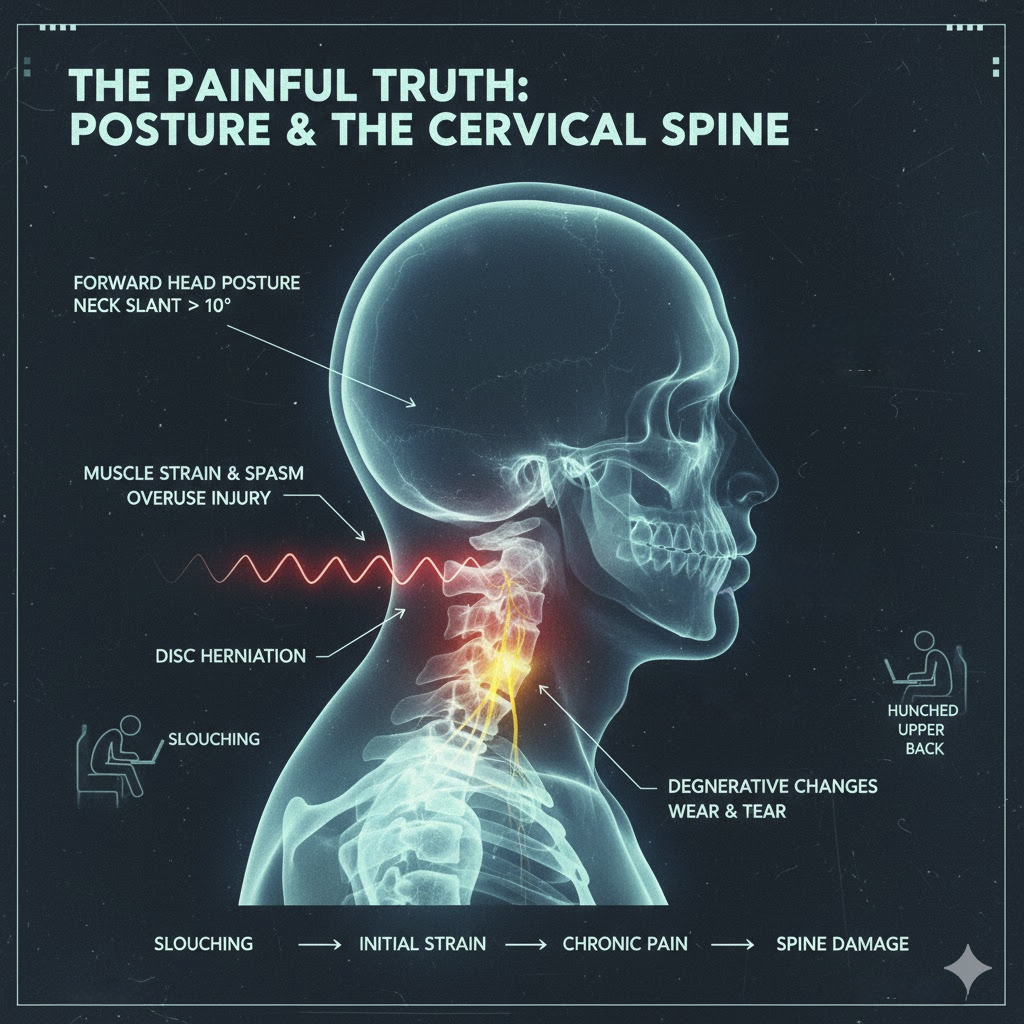
Poor posture, such as forward head, slouching, and a hunched upper back, can cause neck pain by straining the muscles and ligaments that support the neck. Forward head posture, where the head is placed in front of the shoulders, and the neck is slanted more than 10 degrees, is an incorrect posture. The longer poor posture persists, the greater the wear and tear on the spine and intervertebral discs. A group of muscles supporting the neck and upper back overwork to balance the pull of the forward head posture. As a result, repeated pulling and overuse can lead to spasms and, ultimately, injury. The initial strain and overuse of muscles, if left unchecked, can progress to degenerative changes in the spine and herniation of the intervertebral disc. This bulging disc can lead to pressure symptoms on the nerve roots, for example, tingling and numbness.
Your cervical spine has a natural forward curve, slightly curving in a C shape. Straightening of the cervical spine and loss of normal curvature put you at a greater risk of injury, intervertebral disc herniation, and cervical spondylosis.
The Three-pronged Approach
We at Home of Homeo help patients take care of their spine with a combined approach of Homoeopathic medicines, posture correction, and regular exercise. A complete recovery offering relief is possible only when the patients meticulously follow all three aspects.
Homoeopathic medicines
Medicines such as Cimicifuga Racemosa are helpful in cases where neck and back muscle pain is caused by excessive use; the pain extending to the affected arm is also relieved by this remedy. Rhus Toxicodendron is another remedy that is beneficial in cases where the neck pain has extended to the back of the affected arm and onto the elbow. Lachesis Mutus is beneficial for patients over 40, particularly females with low bone mineral density. Other medicines, including Arnica Montana, Atropa Belladonna, and Lachnanthes, are helpful. Albeit these medicines should be consumed under the guidance of a Homoeopathy practitioner. The doses and duration of Homoeopathic treatment are determined by the intensity and severity of the complaints, the affected side, the patient’s age, and the patient’s overall health.
Posture Correction
Most of the cervical spine complaints can be addressed with simple posture corrections while sitting, sleeping, and working at a desk.
The workstation must always be ergonomically correct, with the desk and chair at a height that keeps the top of the laptop or desktop screen at eye level. Place your screen directly in front of you to avoid twisting your neck.
Choose a chair that supports your spinal curves so that your feet rest flat on the floor/ footrest and your thighs are parallel to the floor. Adjust the armrest to ensure the elbows are well rested.
Your work posture is not the only one that needs correction. A generally good head position is when the ears are directly above the shoulders, with the chest open and shoulders back.
Use a telephone headset to avoid holding your phone between your shoulder and ear while doing other things, such as typing, writing, or other chores.
It is advisable to sleep on your back with a medium- to thin-pillow to support your neck. Avoid sleeping on your abdomen or sides with your arm below your head.
Exercises
The simple physical training exercises we all performed in school as children can be beneficial, while physiotherapy interventions such as traction are used in severe cases.
It is essential to understand that the cervical spine relies on the neck muscles to maintain its normal curvature. Isometric exercises help strengthen these muscles and support the cervical spine well. Cervical stabilisation exercises, such as the chin tuck, can be performed in a neutral neck position.
Typically, the neck and other exercises should be performed in the morning and again in the evening after work, holding each exercise position for 30 seconds.
In conclusion, sedentary lifestyles and poor posture, such as slouching and forward head posture, are contributing to an increase in neck and upper back pain. This can progress to cervical spondylosis and nerve involvement if not addressed. A three-pronged approach, combining Homoeopathic medicines, posture correction, and regular exercise, is recommended for effective treatment and prevention.
References
- Materia Medica by W. Boericke
- Textbook of Orthopaedics by J. Ebnezor
- Homoeopathic Therapeutics by Lilienthal
- Head Posture and neck pain of chronic non-traumatic origin: Archives of Physical Medicine and Rehabilitation
First Published on September 15, 2020
