
Approximately 20-30% of the total population in India is affected by at least one allergic disease, with 15% of patients developing bronchial asthma. Urban children have a higher prevalence of allergies than rural children, with a male preponderance. Approximately 4.5% of adolescents are allergic to food items, leading to asthma, rhinitis, or both.
Over the last 25-30 years, the incidence of allergic rhinitis, asthma, food allergy, or sensitivity, and atopic dermatitis has sharply escalated. There is an increased burden of allergic diseases in lower- and middle-income groups. There has been a rising prevalence of food allergies over the past few years, especially in developed countries. Approximately 1 in 13 children worldwide are affected by food allergies in developed countries.
At Homeo, 30% of all cases are allergic rhinitis.
Understand Allergies
An allergy is defined as an exaggerated immune response to a typically harmless substance in the environment. These disorders are caused by an inappropriately vigorous innate and/or adaptive response to an antigen which possesses little or no threat.
The word “allergy” was coined by two paediatricians: an Austrian, Clemens Peter Freiherr von Pirquet, and a Hungarian, Bela Schick. The etymology can be traced back to the Greek words “allos,” meaning “other,” and “ergon,” meaning “action.” In 1871, Charles Blackley, a Homoeopath, discovered the association of pollen and allergies.
The possible causes of allergies
A wide range of factors can cause or aggravate allergies or increase the severity of one’s response to allergens. These issues include obesity, Vitamin D deficiency, changes in the human microbiome due to rapid urbanisation, early-age antibiotic interventions, changes in diet, and an increase in allergens due to rising pollution levels.
Role of the immune system in allergies
The type of hypersensitivity in allergies is the immediate type, in which the response occurs within seconds or minutes and is largely mediated by IgE-type humoral antibodies. These antibodies sensitise basophils/mast cells to release substances called anaphylactic mediators, such as histamine, serotonin, vasoactive intestinal peptide, chemotactic factors, and leukotrienes, which can activate eosinophils. These are responsible for increased vascular permeability, smooth muscle contraction, increased gastric secretion, and increased nasal and lacrimal secretions. All these responses lead to allergy symptoms — sneezing, nasal discharge, wheals, and hives.
Some common allergens include house dust, dust mites, pollen, spores, mould spores, and animal dander, as well as food items such as peanuts and nuts, perfumes, cosmetics, insect bites, and stings.
The difference between a common cold and allergic rhinitis
A common cold usually has a slow onset and no clearly identified allergen association. Whereas, in the case of an allergic disease, one can identify the triggering allergen.
Allergic rhinitis typically has a sudden onset and is characterised by increased sneezing and thin, watery nasal discharge. The secretions in the common cold have an infectious origin and are usually thick, starting white or yellow and sometimes turning green.
The common cold is typically associated with systemic symptoms, such as body aches and fever.
How to differentiate between food allergy and food intolerance?
Most of the time, symptoms that develop after consuming certain foods are due to food intolerance. Symptoms of food intolerance are usually less severe and limited to the gastrointestinal system, such as vomiting and diarrhoea.
A true food allergy manifests through systemic symptoms, such as swollen lips, difficulty breathing, wheezing, and a drop in blood pressure, along with gastrointestinal symptoms. Food allergies can be life-threatening if not treated immediately.
Are allergies genetic or environmental?
Allergic diseases are influenced by genetic predisposition and environmental exposure. Allergic diseases are complex conditions resulting from the combined effect of multiple genetic and environmental factors on their pathophysiology. Allergic disease is likely to result from environmental stimuli acting on genetically susceptible individuals. If there is no close relative with allergies, the chance is 12%. However, even if one parent has an allergy, the incidence rises to 30-50%, and if both parents are allergic, the incidence rises to 80%.
When to see a Doctor?
Allergies can sometimes cause severe symptoms, such as difficulty breathing, swollen lips, and angioedema (swelling of the deeper layers of the skin). All of these are medical emergencies. They must be treated immediately by a medical doctor; the patient may be hospitalised for treatment.
In cases of local allergies such as hay fever, urticaria, and allergic conjunctivitis, Homoeopathic medicines can be beneficial.
Homoeopathic management of allergies
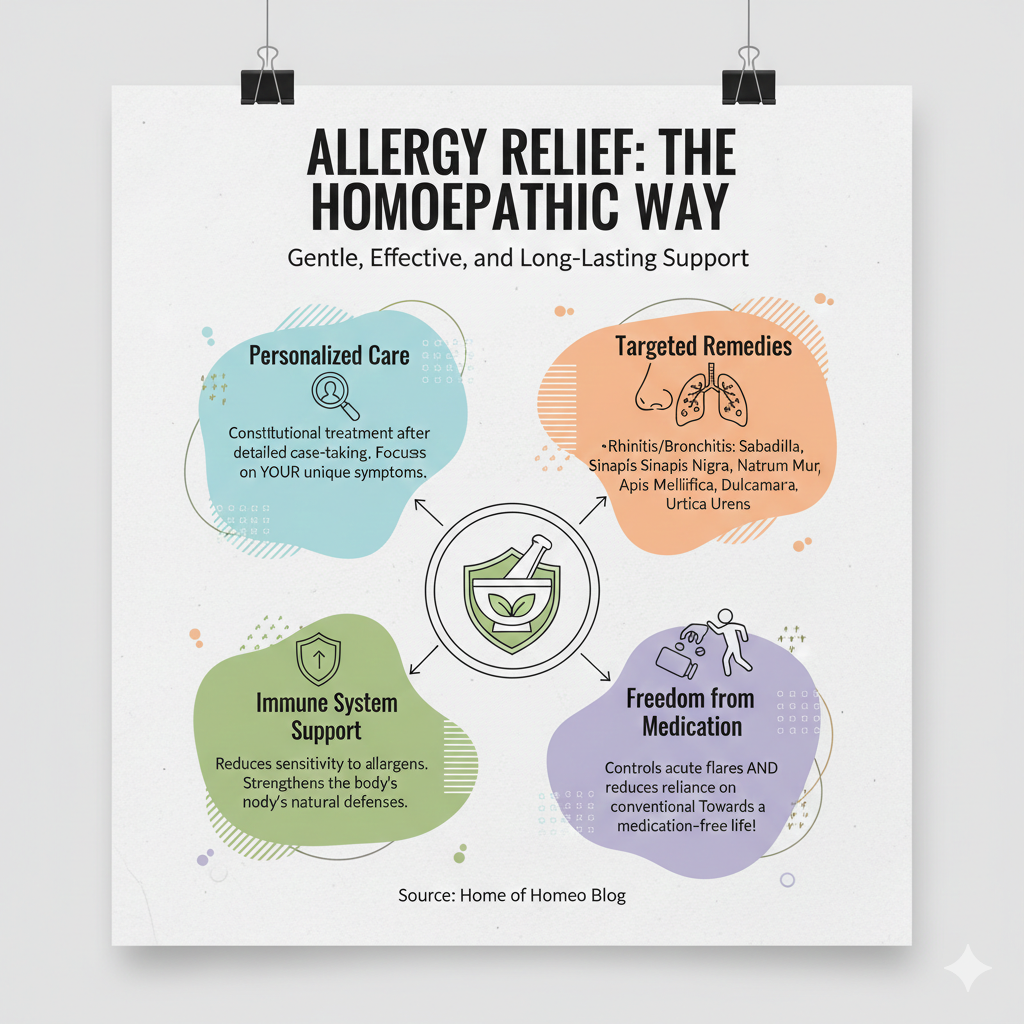
Homoeopathic constitutional treatment can be given after detailed case taking for patients with allergies.
The medicines vary depending on the site of affection and symptoms. Sabadilla, Sinapis Nigra, Natrum Mur, and Arsenic Album are beneficial in the treatment of allergic rhinitis and allergic bronchitis. Apis Mellifica, Dulcamara, and Urtica Urens are of great aid in cases of skin allergies, such as urticaria and hives, which present as symptoms.
At Home of Homeo, Homoeopathic medicines are prescribed not only to control acute allergy flares but also to reduce sensitivity to the allergen by working on the immune system. With treatment, reliance on medications to control allergies is reduced, allowing patients to lead a medication-free life.
Path-lab tests and investigations
Allergies can be tested using a skin prick test or a blood test. The skin prick test is performed on the forearm with suspected allergens. If you have an allergy, then redness will develop at the site of contact with the allergen. Skin prick tests yield results faster than blood tests, but they also carry a higher risk of false positives.
Moreover, in skin-prick tests, multiple pricks are performed. Therefore, these tests are not recommended if you have a skin condition such as eczema or psoriasis.
Blood tests, on the other hand, involve a single-prick blood collection. The results are usually available within more than 48 hours. Blood tests are highly recommended when there is a possibility of a severe allergic reaction to the prick test.
There are two types of blood tests used for allergy testing. The RAST test is used to identify the allergen, and the Absolute Eosinophil count and total serum IgE test are performed for quantification.
In summary, allergies are increasingly common and can significantly impact quality of life, especially as both genetic and environmental factors contribute to their prevalence. Early recognition, timely intervention, and appropriate management—including traditional and Homoeopathic approaches — are essential for effective control. With continued awareness, improved diagnostic methods, and tailored treatments, individuals with allergies can achieve better health outcomes and potentially reduce their reliance on medications, embracing a fuller, healthier life.
Prevention and tips
- Maintain a diary to record your daily diet, especially on days when you experience an allergy flare. This will help you identify the triggering allergen.
- In the event of a severe allergic response, consult your doctor and obtain information on the use of autoinjectors.
- Make sure you inform your doctor and HCP regarding your allergies beforehand.
- Follow a histamine-free diet.
List of foods to avoid or consume in less quantity
- Fish like Tuna and mackerel.
- Chicken, eggs, and egg-based mayonnaise
- Spinach.
- Fermented foods like idli, dosa.
- Soya bean, red pepper paste.
- Yoghurt/ curd.
- Tomatoes and tomato ketchup.
- Instant foods.
- All nuts, including peanuts and walnuts.
- Chocolates.
- Oily and fried food, processed food, foods with monosodium glutamate.
References
- Harsh Mohan’s Textbook of Pathology.
- Kuby Immunology by Barbara Osborne and Janis Kuby.
- 70 years of Clinical Homoeopathy by Dr Koppikar.
- Journal of Allergies and Clinical Immunology- genetics of allergic disease by John Holloway and Ian Yang
- Living with Allergies by Dr Dhiraj Nanda (PDF) Allergy Situation in India: What is Being Done?
- Janeway’s Immunobiology, 9th Edition.
First Published on August 28, 2020
